
The story in detail
Communication includes gestures and facial movements as well as words. This study explored whether one brain implant could decode attempted speech and gestures together in people with paralysis. Researchers used high-density cortical recordings in three participants, first assessing separate movements and then translating simultaneous or separate attempts into control of a virtual avatar. Training on both kinds of examples improved performance across contexts.
The advance is the possibility of supporting multiple communication channels from one recording system. It is not yet an everyday product suitable for everyone. The sample was very small and the method required an implanted device. Long-term safety, performance across conditions and use outside the laboratory remain important questions before broader clinical adoption.
Updated: 20 October 2026 · Study date: 2026-09-14
What was found?
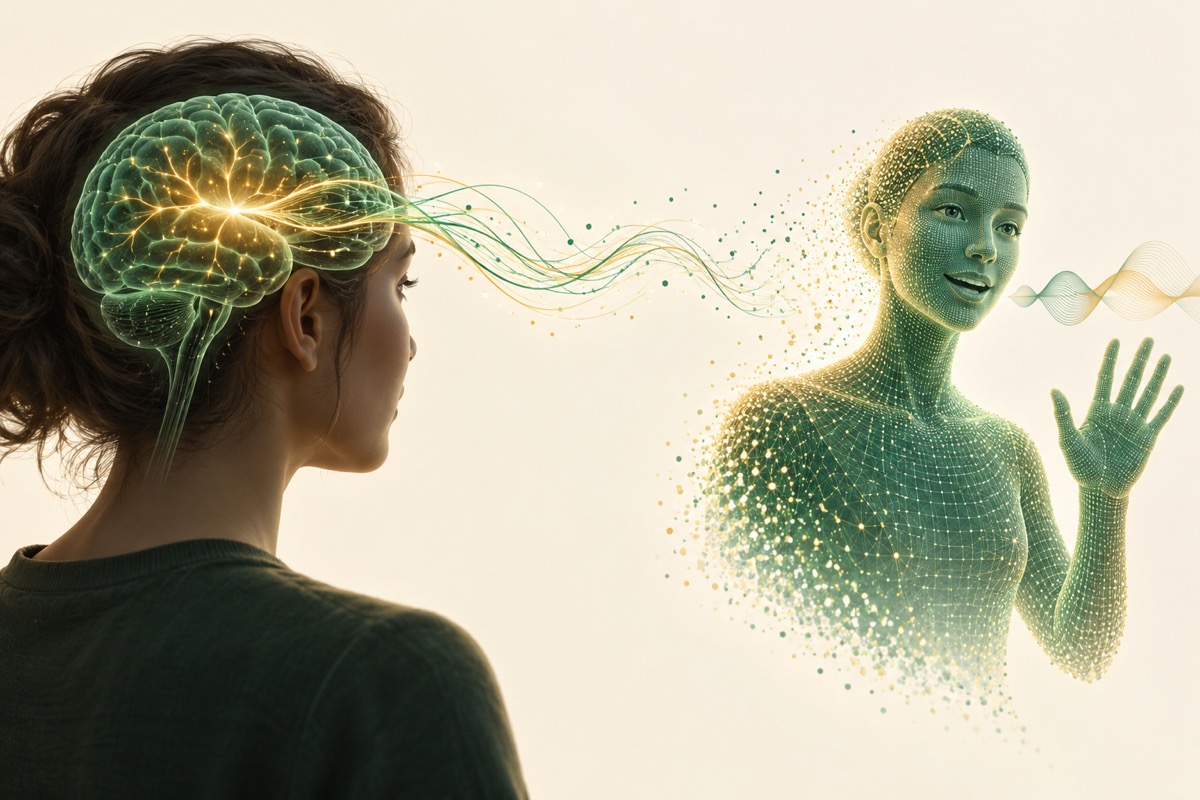
Implanted electrodes translated brain signals into an avatar’s speech and upper-body movements. Three people with severe speech paralysis participated; simultaneous speech and gesture decoding was tested in two, using limited word and movement sets.
What does it mean?
Adding gestures such as waving may eventually support richer communication than words alone.
Limitations
This was a small proof-of-concept study requiring surgery. It does not reverse paralysis or provide a device ready for everyone. Longer-term use and broader testing are needed.
Sources and review scope
English adaptation of the reviewed Turkish edition. The translation preserves its study population, uncertainty and limitations. It is not an independent new study review. Translation checked: 20 October 2026.
Editorial expansion: 21.10.2026
Keep this story
Feedback to the editor
Only the editor can read this; it is not a public comment. Do not include personal health information.
Sign in to send feedback