
The story in detail
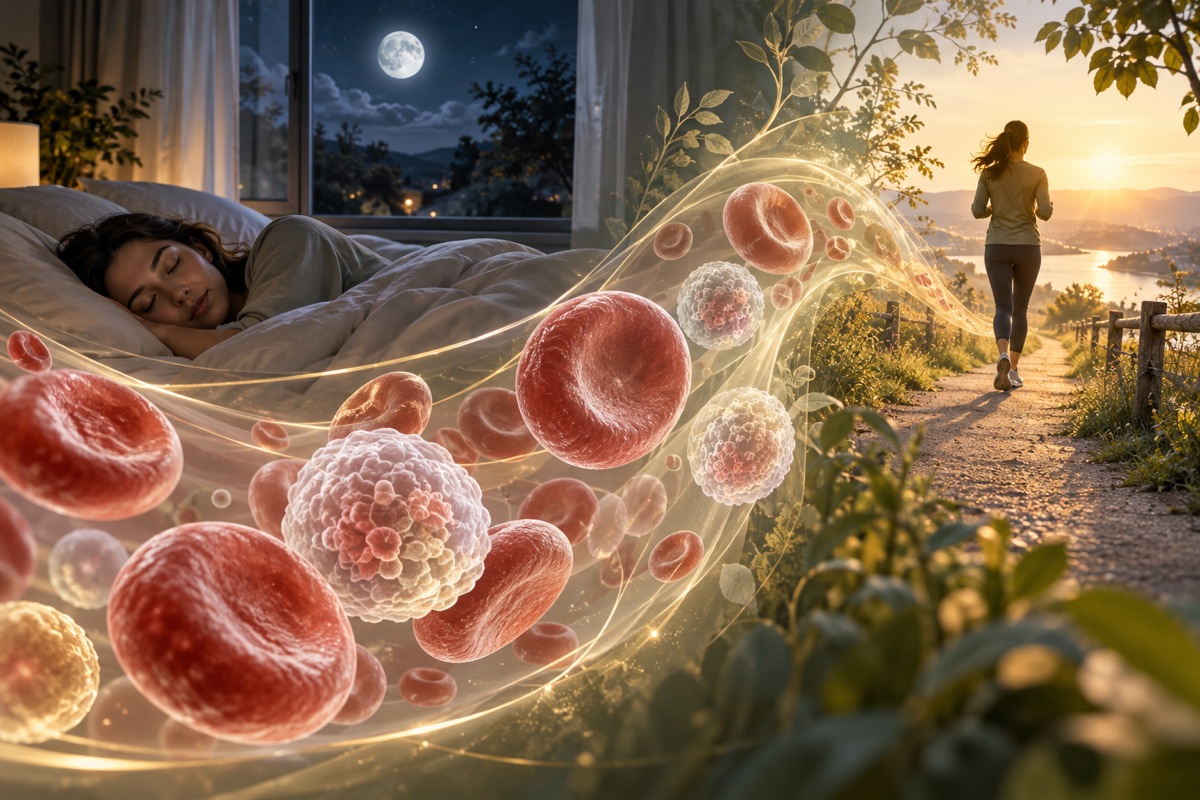
Some blood-cell populations expand with age after acquiring particular mutations. Researchers asked whether sleep and exercise affect these clones differently depending on the mutation. Human datasets linked activity with lower prevalence of some forms of clonal haematopoiesis. Mouse experiments found that uninterrupted sleep or exercise reduced expansion or inflammatory behaviour for certain mutations, but responses were not uniform.
The results suggest that lifestyle effects can depend on biological context. However, the human component was observational and much of the mechanistic evidence came from animals. This does not establish a mutation-specific exercise treatment or justify changing haematological follow-up. It provides a framework for studying how lifestyle and cellular genetics interact, rather than a reason for routine genetic screening.
Study date: 2026-06-10 · Story: 20 October 2026
What was found?
Human datasets linked greater physical activity with a lower prevalence of some forms of clonal blood-cell production. In mice, uninterrupted sleep and exercise limited expansion of blood-cell clones carrying particular mutations.
What does it mean?
The findings suggest that lifestyle and mutation type should be considered together when researching these age-associated cellular changes.
Limitations
Human findings were observational, while mechanistic experiments involved mice. Effects were not uniform across mutations. The study does not establish that exercise treats this condition in people or guarantees a reduction in cancer risk.
Sources and review scope
Original article (DOI) · Reviewed source 1
Original Nature abstract reviewed; human associations and mouse experiments distinguished.
Sources last checked: 20 October 2026.
Editorial expansion: 21.10.2026
Keep this story
Feedback to the editor
Only the editor can read this; it is not a public comment. Do not include personal health information.
Sign in to send feedback